
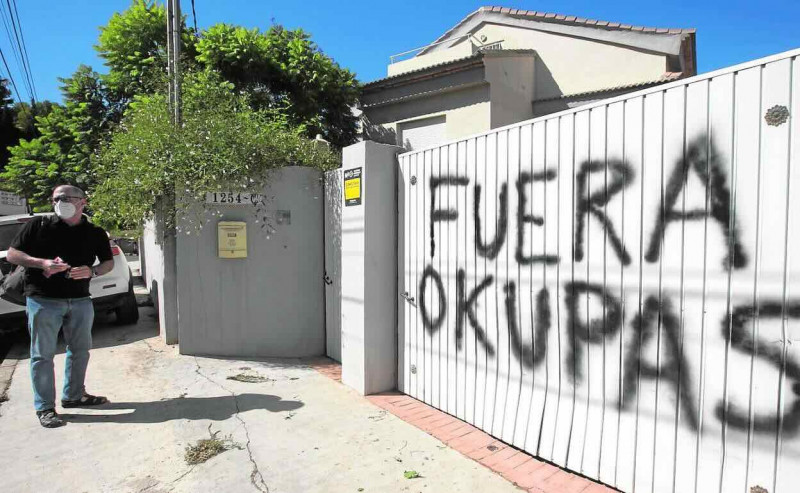
A squatter, or as they call it in Spain, okupa, is a person who lives in a property without the owner's consent. The squatters in Spain and the movement they represent have attracted more and more widespread attention and debate in the country in recent years. Every year, 15,000-17,000 apartments are occupied illegally, a significant majority of which (43%) are in Barcelona and its surroundings, but apartment reservations are also common in Valencia and Andalusia. The tenants have created a market situation in which the owners are afraid that if they rent out their property, the tenant will stay there without paying, so they ask the tenants for half a year or even a year in advance.
This article aims to present the phenomenon of squatting in Spain, its background, frequency of occurrence and how to prevent it. We also give some advice on legal and other practical ways to get rid of uninvited "guests".

THE OKUPA MOVEMENT IN SPAIN
The occupation, also known as the "occupation" or "occupation" movement, has a long history in Spain. The first known cases appeared in the mid-20th century, when some young activist groups began occupying vacant buildings to protest housing problems and economic inequality. The Occupy movement grew rapidly and lives on in the 21st century. In the Spanish language, the letter "k" is almost never used, but in the word okupa, it is exceptionally so. This also symbolizes a kind of rebellion, promoting deviation from the traditional.
BACKGROUND AND REASONS
There can be many reasons behind the occupations. These include:
- Housing problems : Due to the high rent prices and the lack of affordable housing in Spain, many people are unable to live in normal conditions.
- Economic difficulties : Since the economic crisis of 2008, many people have lost their jobs and are struggling financially. The only way to get free housing is to move into abandoned properties
- Protest and activism : Occupations are not only on the rise due to housing problems, but also carry social and political messages. The Occupy movement was created as a protest against state real estate policies and speculation.
Development of the number of squatters by province
RESIDENTS IN SPAIN - IN THE MIRROR OF THE NUMBERS
If we look at the latest data for 2022, published by the ministry itself, which analyzes what happened in the first seven months of the year, we see a 23% increase in apartment bookings in Valencia and a 15% decrease in the Community of Madrid. In Andalucia, Seville, Cádiz and Malaga, Casares and Manilva have the highest number of apartment bookings.

There are two different models: one that is permissive of foreclosures, the other that protects private property, and of course the one that protects the victims of foreclosures, who in the vast majority of cases are families, small savers who own their homes, and who see their rights being violated. Therefore, the problem of apartment reservations sends a terrible message to the market, with a clear victim, who are once again Spanish families" -

LEGAL BACKGROUND
First of all, it is important to state that taking possession against the will of the owner is punishable under the Spanish Penal Code. It does not matter whether this possession is by force or not, there is a penalty for it.
Second, we must distinguish between two types of crimes:
- The crime of burglary (Codigo Penal Article 202)
- The crime of trespassing (Article 245 of the Codigo Penal)
The difference between the two concepts is what the law protects. In the case of burglary, exactly this: the victim's home, the place where the victim lives his daily life. In trespassing, on the other hand, it is the property right that is protected. This is typically the case for abandoned, empty, under renovation or construction houses or flats where the owner does not live.

"The main difference between the "occupier" and the "non-paying tenant" is that the former took possession of the property illegally, while the latter did so with the landlord's consent and within the framework of a contractual relationship.
Therefore, the method of evicting a non-paying tenant will be through civil jurisdiction and the action will be based on breach of contract.
As for the "occupier of an apartment", it is preferable to apply the criminal procedure, although we must distinguish between the crime of burglary and trespassing. In the case of the former, the tenant illegally enters the property constituting the family home, and in the latter case, the tenant moves into a place other than the family home or the family's usual or permanent residence"
Carlos Hering – lawyer

YOU MUST REACT IMMEDIATELY, OTHERWISE THE CASE MAY BE DRAGGED
What is the first thing you should do? Call the police.
5/2018 published in the official gazette (BOE). Law no. states that you must file a report within 48 hours of taking possession. In this way, the occupied apartment is considered the victim's home, the entry is considered burglary and not trespassing. Occupiers know this exactly, so after moving in they usually order, for example, a pizza and keep the block. If the owner notices that strangers are living in the property only after a few days, i.e. after 48 hours, he can only have the apartment occupied filtered through legal proceedings. The police can only evict you immediately without a court order if the residents have not been in the property for 24 hours. Unfortunately, this cannot be done so simply in practice, and the result is that the squatter remains in the property.
It often happens that the owner rents out the property in the long term, the tenant pays for a few months, and then "forgets" to pay after a while. Well-to-do families, with luxury cars, operating businesses and all other positive promises, rent apartments and villas and after a while "circumstances change" and the tenant stops paying. Unfortunately, this is quite common, which is why the owners no longer trust anyone, they ask for half a year or several months in advance, and they don't even pay the agent, they also try to put the commission payment on the tenant. This also contributes to the fact that in 2023 it is difficult to find a property for rent, and at a much higher price than a few years ago.
You can read about the increase in rental fees in our previous article.
HOW CAN YOU DEFEND AGAINST TENANTS?
Alarms connected to an alarm receiving center. This type of alarm is extremely effective. The reason for the high level of security they provide is that there is always a special team to receive and handle alarms. If you would like to request a quote for the installation of this type of alarm system, our colleagues will connect you with reliable service providers.
Reinforced doors or doors with special anti-burglary locks. They are designed to prevent penetration and are impermeable from the outside. They cost around €1,000 and are mounted on the door frame to be protected.
Grilles or window guards. As before, with the aim of making it impossible and blocking entry from the outside, you can reinforce your windows with bars or window grills.
Well-kept garden. If the property gives the impression that its garden is not abandoned, its garden is well-kept, the bushes and plants are well-kept, then it is less likely to be noticed by the tenants.
Your mailbox is constantly being emptied. If the mailbox is stuffed with letters and advertising materials, it can be concluded that no one has been there for a long time. Unfortunately, this is also noticed by apartment renters, and the owner can easily find an apartment renter the next time he wants to enter his property.
Several businesses have been established that advertise the service of helping uninvited guests leave as soon as possible. They usually conduct negotiations between the owner and the occupier, and their visits primarily demonstrate strength. An example is the anti-occupier group, where several of our Hungarian compatriots work:
HOW TO GET RID OF TENANTS?
The legal method is to evict the illegal tenant through litigation. Lawyers usually promise 6 months, but in practice there are cases that have been going on for 3 years, and the end of which is still not in sight. If the tenant of the apartment has a minor child and the child also lives in the property, the court will issue the eviction order much more slowly, and the occupier will be granted more and more reprieve. The other method that can be used to extend the litigation for a very long time is if you cite health reasons, the resident and hospital final reports prove that you cannot be put on the street because your health condition does not allow it. There was also a tenant who requested and received a grace period due to breast augmentation surgery.
Many times, in order to speed up the process, the owner offers money to the tenant to leave, which is around €10,000 on average. There are squatter mafias who can generate quite serious income by moving squatters into apartments and after a few months they are already negotiating the size of the amount. Let's not think that the illegal tenant is a homeless unfortunate person, there are people who drive Porsches and spend thousands of euros per month, but do not legally live in the luxury villa.
There was a Hungarian owner who didn't even start this protracted legal battle he was already familiar with, but instead asked a skilled locksmith to break the lock and replace it when the tenant left home. After that, he took the squatter's belongings to the street in garbage bags next to the trash can, leaving no trace in the apartment that a squatter had previously lived there. With the title deed, he waited to see if the uninvited guest would dare to return, because he would immediately call the police and file a burglary report. In this case, the delinquent did not even try.